bahamagarden

Tiff’s Bahamian garden tips and some natural alternatives

Sunday, January 14, 2007

Adam and Kat's Garden

There is truly nothing that makes me happier or brings me more joy than to share gardening with someone. It is twice as sweet when I help someone get into it. Apart from the fact that it makes me feel like I know my gardening shite, I love watching someone's mind expand with the realization of the many possibilities.

I had such an experience this weekend in Nassau. I went over for business on behalf of my brother Adam and stayed the weekend to spend time with him and meet his new girlfriend, Kat. I had a great time with them both. Not only was it wonderful to finally meet Kat and find her to be a sweetie, but she asked me to help her do some gardening!! She's in as far as I am concerned!

God bless her, she had already gotten everything we needed. Soil, pots and a spade along with the bulbs and seeds her Mum had given to her. A very health-conscious girl, her first priority was planting seeds for vegetables and herbs. However, upon beginning, we decided to look at the garden as a whole and make a plan for where these items would go. Needless to say, and despite being very hungover, we formulated a plan on how to best utilize the limited space and enhance the 1970's decor, inclusive of the slightly dingy pink walls enclosing the back porch. "Can't go wrong with a plan" was the order of the day.

Adam was asked to hang the bird feeders, nest and woolie, then got right into the spirit, beginning to weed out the backing flower beds overrun with mother-in-law's tongue. These tenacious plants had even broken many of the large green tiles situated as an extension to the green concrete porch. ( I did say 1970's decor!)


Plan firmly in our heads, (and me to commit to paper at a later date) we proceeded to pot and label the herb and vegetable seeds, lining them against the wall to get decent sun throughout the day. Had we had more time, ie not hungover, we would have ascertained the right areas for sun exposure by paying attention! C'est la vie, so we guesstimated.


Then we moved to planting the bulbs. Once done, we placed them under the covered area of the porch.Of course, I can't walk away without getting my hands in the dirt, so I weeded some of the mother-in-law's tongue and cleared an area, whereupon a small seagrape tree was discovered. With the area cleared and the seagrape in plain view, the garden began to be seen in a different light. We could actually see what it was going to become. A small sanctuary for parties, dinners, meditation, yoga, hanging out or just reading. Kat's cat Taj had a ball outside with us and has truly discovered his outside cat persona.


Before it got too dark, we decided to take a ride to see some property Adam is going to be building on. On the way there, I was looking around at the great foliage Nassau has. It is nothing like the "rock with some scrub on it" Freeport is. It has more varied terrain and soil, boasting some of the prettiest colonial style houses, a true island feel. Just as I began to convey to Kat the possibilities of clippings, she laughed and said she was thinking that Adam was going to be coming home one day from work and see her on the side of the road taking clippings. She is well and truly bit by the gardening bug!

That night we ate a wonderful meal Kat prepared on the garden patio . I look forward to my next visit to see how Kat's garden grows.


Sunday, September 17, 2006

Crape Myrtle


This versatile bush/shrub/hedge/ tree is just great. It has colourful flowers with curled crepe paper-like petals. The colours range from white, pink, yellow, red and purple. They like the heat and are okay with a little dry. Moderate watering and good drainage is recommended.

However, what I like most is that it can be any of the ways I mentioned above. If you want a bush, don't trim it from the base of the plant. Obviously do the regular trimming once a year to keep it thick. It will form a bush with long branches, heavy with the flower clusters.

Planted close together, they form a nice thick hedge. Trimming applies as if a bush. However, if the new growth is trimmed from the the base of the plant, focusing the main growth on three or four strong thick middle branches, it will form into a tree. See extra information on pruning here:

http://hgic.clemson.edu/factsheets/HGIC1009.htm

The Crape Myrtle grows everywhere in North Florida and reminds me of a time I spent living in Jacksonville. I still have a lot of family, friends and memories there, so these in the yard make me feel close.

On a trip recently to Las Vegas to see a dear friend, I saw them planted on the roadside verges. Of course, they were watered by sprinkler systems, but if they can grow in the desert, they can grow here - in any form you may choose!

Saturday, September 16, 2006

Frangipani v. Desert Rose

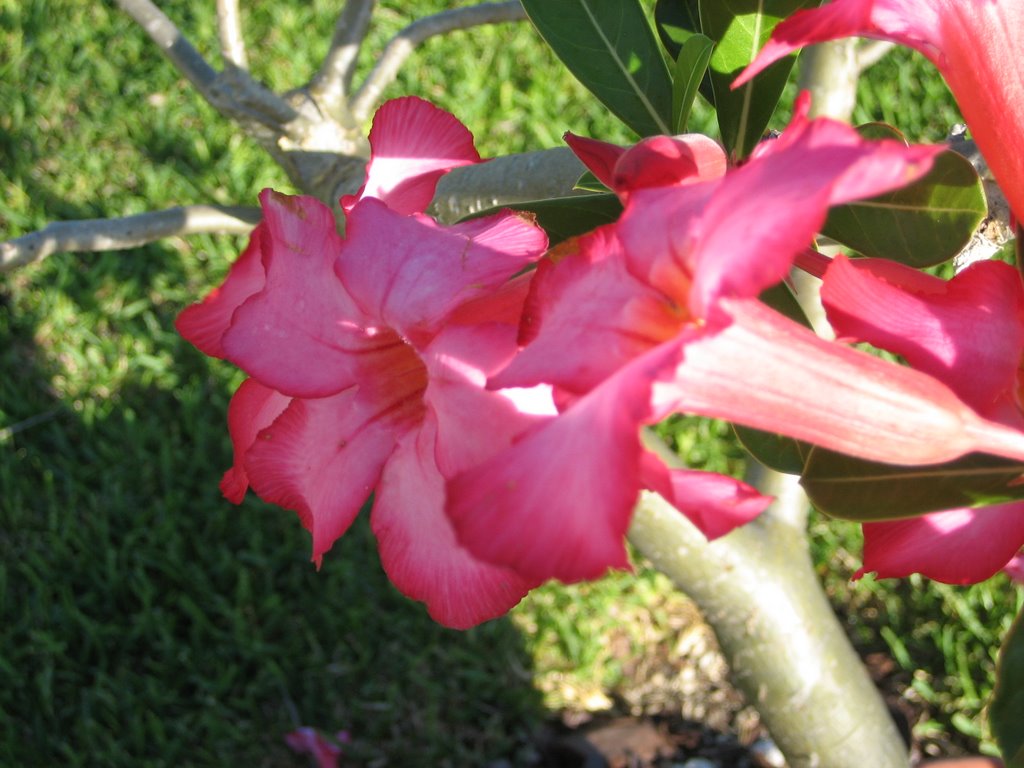
I love the desert rose. It is pretty and simple to care for, grows better in pots and does not require a lot of attention to be beautiful. Obviously, it does not like to be wet all the time, but does require moderate watering. It comes in other colours than the standard pink/fuschia. See above photo.

They do well here and are popular. Someone locally grows them from seeds - I have no idea how, but they turn out beautiful. So when I saw what I thought were large trees of them in Nassau, I was enthralled. Then I learned that they were indeed not the desert rose, but the frangipani.

The frangipani, like the desert rose, grows well here without too much attention. They require moderate watering as they are prone to rot if they are too wet for too long. They are also easy to take clippings from. Just clip at the base of a new branch growth and stick in good soil and lots of sun. My gardening "partner in crime" and I have taken a tour of friends' houses where we have seen plants we want clippings from (a true gardener notices everyone's garden). From these I have gotten a white/yellow and a red frangipani. The below picture is the white/yellow taken from a clipping of a larger pant. It suffered a bad weedwhacker incident last year, but has come back great! Hardy buggers!


I have seen the desert rose in pots growing as high as 6 foot. The frangpani on the other hand is a tree and gets much larger. The big leaves and ever reaching branches make this tree a wonderful place for a shady spot, without a lot of debris in autum to worry about.

Fruit Trees


Plant damn friut trees people!! I don't know if it's because of my Jamiacian heritage, but I find it crazy that more people do not take advantage of what we can grow here in the way of fruit trees. While we may have to put a little "extra" into rearing healthy fruit-bearing trees, it is so worth it. To the left is a photo of our papaya tree one year after planting. It bore fruit the very first year. My husband calls it "super tree", so that's what it's known by. This year it is taller than me (not hard, I know).

As a general rule with the trees in the yard, I clear the grass from around the base, place a rock border and keep the area created free from grass and weeds. This prevents the growth of grass strangling the tree out. The funny thing about grass, we pay for loads of it in squares and then fight to keep it from taking over forever after. Inside the area created, I use marigolds to keep away bugs, and their roots are not intrusive to the tree. Or, I use mulch/pine nuggets to keep down weeds and keep in mositure.


The papya tree is different to grow though. It is either a male or female plant. The females are the only ones that flower and fruit. I understand that a female tree will only bear fruit for a period of time and then after that never again. I'm usure of what age, so I intend to cultivate another couple of females soon.

Other fruit trees in the yard are guava, mango, sapodilla, avocado, peach,
ackee, bananas, coconut, star apple and I will put in seagrape soon.


Sunday, September 10, 2006

Herb Gardens

Herb gardens

The smell that wafts through the air when I water my herb garden reminds me of the South of France. It may be that my rosemary bush is huge and that the parsley is likewise. The rosemary is green and lush, bearing little purple flowers. I am considering making a hedge of this in the front of the house where we cannot put in a fence. It will be full and green all year long; low lying so as not to break any property restrictions for the area.The below photo is the rosemary and parsley plant.


It was rocky going with the herbs at the beginning but once they took hold, they really flourished. They needed a lot of attention at first but eventually grew stronger. I find the basil really needs a lot of water and is the first to show signs of dryness. I crop the heads off of the stems when they begin to bloom. I was told that it keeps the bush strong and it seems to work. Making fresh pesto is quick and easy, and tastes best when plucked minutes before pouring over pasta. http://www.dianaskitchen.com/page/sauce/pesto.htm

The parsley is likewise as the basil. Clip and use often to allow for more rapid new growth. Great chopped in boiled potatoes or on eggs benedict in the morning.


I also grow thyme, which really needed a lot of attention in the beginning. I acually lost a plant or two before I got it right. It is worth the effort though, as this is a versatile herb and gets used a lot in soups and stews to name but a few dishes. Good soil, water and sunlight all have to be right for this picky plant. Try all combinations until you find the right light.

I have planted elephant ear plants throughout my herb and future vegetable garden to create some shade in the searing sun here. See below photo.

Summer is obvioulsy not the time to plant. I have found if herbs are planted over the cooler months, by the time summer comes around, they have a better chance of surving the dryness and heat. However, the plants will look healthier in cooler months.

Mint, once it takes, grows like a weed grass with small pretty purple flowers. It smells great, looks pretty and is perfect for Indian food and exotic drinks. Wild basil (or thyme, I am not really sure-everyone seems to have a different opinion) grows strong and gets large. It is also great in Italian foods like stuffed shells. A note to remember, especially if you use snail bait and pesticides: wash your herbs well before using. Also, dried herbs have a weaker flavour than when using them fresh, so bear in mind when implementing.

I love the fact that when I am cooking, I can go to the bottom of the garden and pick fresh herbs. Eventually, when I have really masteredmy herb garden, I'll grow more in the way of vegetables to go with these herbs. The less I have to go the Winn Dixie - the better.

Glory Bush


These simply stand up to their name. Plant where they will get morning sun, good drainage, regular watering and you will reap the benefits. The blooms are light purple trumpet like heaven. They grow tall and large so make room for the growth. If the branches can grow horizontally, it will sprout new branches that grow straight upward for more blooms. And the more the merrier because the blooms are sadly, not long lasting.

They have a nice fragrance which unfortunantely attracts wasps. I have to say though as much as I am around the plants, watering etc. I have never been stung due to mutual respect - I hope. (now, I put mout' on it!)

Sunflowers


Who does not love the heck out of sunflowers. An array of sizes and a range of colours, these flowers always bring a warm smile to any guests face. And they are easy too. Take seeds, throw into a pot or ground with good drainage and soil, stick in the sun and water regularly. BAM!

If in a pot allow for whatever size of the species you have selected as some can grow very large. And likewise if in the ground the roots need somewhere to be able to grow.


A note to remeber is that they produce their own seeds. If you are not drying the seeds to eat them, harvest from the flower head after petals have dropped. Look for the seeds to be loose and mature. Keep in a cool dry place for later use, or plant right away to continue the floral sunshine.

It's also fun to watch the flower heads move through the day following the sun, trying to capture every drop of the rays!

Creative Gardening

Look for something fun and different to put in your garden. I have seen (and tried) a bathroom setting in a garden. A bathtub layered with rocks, mulch and soil for adequate drainage through the plug hole in the tub. This created a wonderful flower bed and similarly did the sink and toilet. This particular garden had wild flowers in the tub, hanging plants in the pedestal sink and a mixture of the two in the toilet bowl and tank. What fun. Use your imagination and incorporate a little of yourself into your garden - anything goes.

I like the idea of my husband's old huge boots as planters. It's a nice twist on the shoes by the front door routine.

Also, look for strange and unusual plants to incorporate into your garden. Sometimes in our dry and soiless area we need to be creative and diversified. I have no idea what the below plant is called but it came from my Mother, to be planted in my succulent garden. The plant consisted of long, thick , green cactus like fingers. I planted it at the back of the garen to let it "do it's own thing" and never really gave it much more thought. So, one day I am watering my garden and when I scanned the succulents patch I almost dropped my hose. I swear I thought that a alien had hatched from it - the flowers & buds on this thing were incredible. Ugly, yes - but cool all the same. See below photo.


So, keep an eye out for things that are a little different, you never know when you will be surprised. I even grow some pineapple and have found it a nice addition to a garden - so try everything and enjoy.

Double Angel's Trumpet

I found this plant's flowers beautiful when I saw them outside my church, and the name so fitting. I watched them until I saw the flowers go to spiky seed pods that eventually split to reveal the seeds clustered inside. I waited for them to dry and plucked them when brown. At home, they grew well in pots until they had to be trasplanted into the ground. Then they took off.

Subsequently, they have always been with me, even during a move. I have learnt that they like full sun, watering makes them healthier and radiant, plus lady bugs love them, and who doesn't like lady bugs. See above photo.

The below photo shows my 'mother bush" in full seed pods, still green. Once they become brown and split, let dry a little longer and then harvest when they start dropping off at a tap. Plant right away or keep till next season. Like all seeds, it's best to keep them in a cool dry place until you are ready to use them.
A massive bonus for me with these gorgeous bushes is that caterpillars love them! I mean big fat, juicy, green ones that become beautiful butterflies. Needless to say, I have harvested from my "mother bush" a new crop to plant around my butterfly garden. This will allow for caterpillars to eat & coccon, then as butterflies they can eat, drink and live with all needs met.

Apart from all of its bonuses, it is really beautiful in bloom. Big green beautiful leaves with white long trumpet-like blooms tinged in yellows. See below photo of my "mother bush" in full bloom.

Below is a photo of a bloom from the underneath view. I have heard that the seeds are poisonous, so if you have kids, be careful. Another warning tip: if your plant is by a walkway of concrete, caterpillars poop stains the concrete, so move the plant!


There are many variants of the angel's trumpet - I have the below large pink tinged trumpet but keep an eye out for any new ones to add.

Friday, August 18, 2006

Orchids

I was so scared of trying to grow orchids that it took me a while to get the nerve to buy one. Now, although not the expert Barry is, I do OK with them. What I have found out is that they do actually like water, just not to sit in it. So I don’t mist, I water them. Two to three times a week, I take them out of their “pretty” second pots and put them all out on the walkway and water them with the rest of the garden. When they have drained, I put them back.


As for sun, they do not like direct sunlight but prefer the dappled sunlight they would get under or in a tree, au naturel, so to speak. I keep mine on the front porch; they get a little early morning sun and nothing else. I do fertilize about once every 6 weeks or so and always put them out when it rains. There is nothing like rain water.

I keep mine in a first “plain” pot and in a bark mixture. I do not repot until really necessary, when the roots have taken over the pot. In doing so, I soak the roots and what of the potting mixture is still attached in water until pliable. During this time, I take the chance to trim off any dead roots. Then use the bark potting mixture, filling the new “plain” pot ½ ways. I place the roots into the prepared pot and hold in place whilst filling the pot the remainder of the way with the mixture. After this, I place the stick that will hold blooms grow in place, as I think needed.

In clipping the dead bloom stalk, in general I clip way back when the last bloom has died. All orchids of course are different, so I look at all internet sources I can for the variants.

Wednesday, August 16, 2006

Butterfly gardens


Who does not love butterflys in the garden. I became entralled with this gardening when I vistsed a butterfly garden on a cruise. Situated within St. Martin, it was fabulous and informative.

I have constructed a little ecological system beginning with double angels trumpet (see Angles Trumpet post) for the catipillars to eat and cocoon on. I have to say, they can strip a bush qucikly too, but then go to cocoon fed and fat. The plant recovers quite quickly to feed another generation and produce their named flowers.

For food within this region, the milkweed is easy to grow and hardy. It produces clusters of flowers that are small , coloured in yellows, oranges and reds (see below picture). The seed pods will then grow and self germinate very easily. Maybe a little to easily so, look for milkweed where you never envisoned them to be. Don't fret, they can be relocated easily.


Another plant is very common to the area and the butterlys love it. I have no idea the name, but a picture is below. It comes in a varity of colours and when left to its own devices, will grow into a low growing bush.


Butterflys do like water, so a dish or bath with sand or dirt saturated with water but not flooded will provide exactly what they need (see below picture). They also like rotten fruit and alochol for extra sugar. I have tried leaving out fruit with a small amount of rum on it - but the beetles are a stronger prescence littering the entire fruit, bath and garden, so I stopped.


I have a wonderful friend who gave me ornamental butterflys one year. The nice thing about a busy butterfly garden is that all items belong within in it and I have butterflys even without it being season. Posted by Picasa

Mexican Sunflower


I know this is not the real name for this wonderful flowering bush, but its the name they were introduced to me as and so it shall remian. (Thanks Mom).

These are easy to grow from stalk cuttings (note: watering post) and will make a beautiful full hedge if maintained correctly (see picture below). Clip back in times of dormant growth so that the stalks do not grow gangley and bare but full and bushy, about once a year. The leaves are large and interestingly shaped and when they have died should be removed simply for looks. They pull away from the stalk easily when brown and hanging.


The blooms are large sunflower types with a honey smell (see below picutre). This smell is wonderful on a breeze in the garden whilst sitting on the porch drinking coffee. The blooms are in full swing during the winter months in this region which makes for nice colour during a usually more barron time.

This bush loves full sun and will flourish when watered frequently but can also survive dryer times.

Enjoy the sight and smell of this easy to grow and maintain bush. Posted by Picasa

Snails, snails, snails..

Well I now have concluded that snails are only good on a plate with garlic and butter - not the garden.

I tried, Oh Lord, I tried to do the humane thing. I used seaweed, I used eggshells, I even had a catch and release program for the buggers. Watered late in the evening and by 9:00pm would be able to just pluck them up, with flashlight in hand and put them ALL in a bag and take them down the road to a new suitable home - but NO!!! They always came back, with friends and slugs. They ate everything but when they hit the sunflowers, they had crossed the line.

I searched the web for all alternatives, and of course found I have given them the perfect home with rock walls for garden bed borders. The watering was just encouraging them to flourish and breed. So my final word on the subject - get a snail & slug bait/ killer and use the hell out of it!

I pray for forgiveness for the murders as I watch my plants return!

Wednesday, June 14, 2006

Vilma Garduation

 Posted by Picasa